
sacstat › Wheel and dice games › roulette
roulette
pockets = 37 | 38Roulette is the clearest example in the subject of a game whose entire margin is visible in its physical construction. The wheel has thirty-seven or thirty-eight pockets. The payout table is written as though it had thirty-six. Everything else follows.
The pocket census
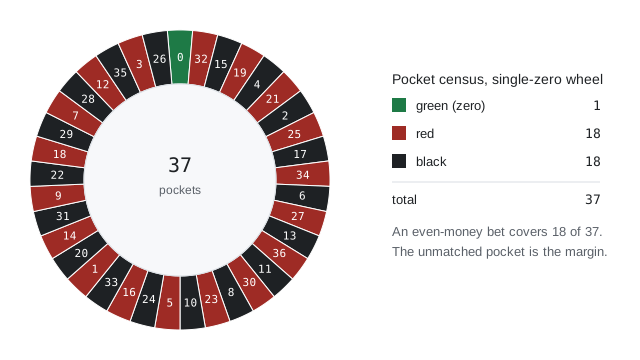
A single-zero wheel carries the numbers one to thirty-six, half red and half black, plus a single green zero: thirty-seven pockets. A double-zero wheel adds a second green pocket, making thirty-eight. The numbers are arranged around the rim so that neighbours differ in colour and in high-low, which spreads any local bias but has no effect whatever on the arithmetic.
Why one edge covers nearly every bet
A straight-up number pays 35 to 1. There are thirty-seven pockets, so the true price of a single number is 36 to 1. Expected value per unit is (35 × 1 − 1 × 36) / 37 = −1/37. A split pays 17 to 1 across two numbers; the same computation gives −1/37 again. An even-money bet covers eighteen and returns −1/37 a third time.
This uniformity is deliberate. Every payout on the table is computed as though the wheel had thirty-six pockets, so every bet gives up exactly the value of the missing pocket. The bettor can choose the shape of the distribution — rare and large, or frequent and small — but not the price.
| bet | pockets covered | payout | expected value per unit |
|---|---|---|---|
| straight up | 1 | 35 to 1 | (35 − 36)/37 = −2.70% |
| split | 2 | 17 to 1 | (34 − 35)/37 = −2.70% |
| corner | 4 | 8 to 1 | (32 − 33)/37 = −2.70% |
| dozen | 12 | 2 to 1 | (24 − 25)/37 = −2.70% |
| red / black | 18 | 1 to 1 | (18 − 19)/37 = −2.70% |
The double-zero exception
On a double-zero wheel the same construction gives −2/38, or 5.26%, on almost every bet — and one bet is worse. The five-number bet covering zero, double zero, one, two and three pays 6 to 1. Five pockets out of thirty-eight paying six is expected value (5 × 6 − 33) / 38 = −3/38, which is 7.89%.
It is the only line on the standard layout whose payout was rounded rather than derived, and it is a useful reminder that the uniformity of the table is a design decision rather than a law.
pockets covered      5   (0, 00, 1, 2, 3)
pockets not covered 33
payout               6 to 1

E[unit] = (5 x 6 - 33 x 1) / 38
        = (30 - 33) / 38
        = -3/38 = -7.8947%

every other bet on the same wheel: -2/38 = -5.2632%
Sequences and the wheel's memory
Physical bias — a genuinely uneven wheel favouring some pockets — is the one mechanism that could in principle break the arithmetic, which is precisely why modern wheels are manufactured, balanced and rotated to eliminate it, and why pocket-frequency monitoring is a standard part of table operations.
Return to the Wheel and dice games index on the reference landing.
Last modified 17 August 2026.