
sacstat › Wheel and dice games › dice and craps
dice and craps
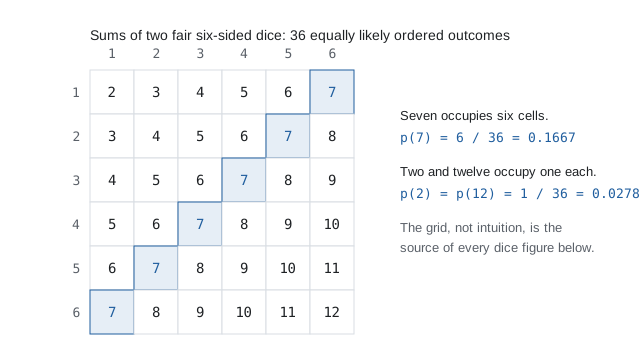
outcomes = 36Two dice produce thirty-six equally likely ordered outcomes and eleven unequally likely sums. Nearly everything interesting about dice games comes from that mismatch, including the one bet in common use whose expected value is exactly zero.
The thirty-six cell grid
Enumerating two dice as a six-by-six grid removes all ambiguity. There is one way to make two and one to make twelve, six ways to make seven, and a tidy symmetric distribution in between. The grid is the source of every dice figure; nothing here requires memorising a table of probabilities.
The line bet
A pass line wager wins immediately on seven or eleven, loses immediately on two, three or twelve, and otherwise establishes a point that must be repeated before a seven appears. The point phase is a race between two fixed probabilities, which makes the whole computation a sum of a few simple terms.
The result is a win probability of 244/495, a shade under one half. The house edge is one minus twice that, or 7/495, which is about 1.41% — among the lowest edges on a casino floor, and a good illustration that a low edge is not the same as a good deal once round rate is taken into account.
come-out:  win  7,11        8/36
           lose 2,3,12      4/36
           point 4,5,6,8,9,10 remainder

point phase: p(repeat point before a 7) = ways(point) / (ways(point) + 6)

  point 4 or 10:  3/36 x 3/9  = 0.0278 each
  point 5 or 9:   4/36 x 4/10 = 0.0444 each
  point 6 or 8:   5/36 x 5/11 = 0.0631 each

p(win) = 8/36 + 2(0.0278 + 0.0444 + 0.0631) = 244/495 = 0.49293
edge   = 1 - 2 x 0.49293 = 7/495 = 1.414%
Free odds: the zero-edge wager
Once a point is established, the rules permit an additional wager paid at the true odds of repeating that point — 2 to 1 on four or ten, 3 to 2 on five or nine, 6 to 5 on six or eight. Because the payout equals the true price, its expected value is exactly zero. It is not a concession or a promotion; it is a structural feature that lets a player enlarge a position without enlarging the margin paid on it.
The consequence is arithmetic rather than strategic: the edge on the combined position falls as the odds portion grows, because the fixed cost of the line bet is spread across a larger total. Nothing is gained; the same expected loss is simply divided by a bigger number, and the variance of the position rises sharply in exchange.
| point | ways to make it | ways to make 7 | true odds | payout |
|---|---|---|---|---|
| 4 or 10 | 3 | 6 | 2 to 1 | 2 to 1 |
| 5 or 9 | 4 | 6 | 3 to 2 | 3 to 2 |
| 6 or 8 | 5 | 6 | 6 to 5 | 6 to 5 |
Proposition bets
The centre of a craps layout carries single-roll wagers on specific sums, and their edges are far higher than the line — often ten to seventeen percent — for the same reason as everywhere else: the payout is written short of the true price. Any of them can be checked in one line against the thirty-six cell grid, which is the practical value of having drawn the grid at all.
Return to the Wheel and dice games index on the reference landing.
Last modified 17 August 2026.